The First Contact!
Door open 20h.
Before and after the main feature Short movies.
20h: Japan 2005, 150min, with english subs

Brilliant to look at, impossible to understand, Funky
Forest: The First Contact, is like a resume reel for a group of
struggling, soon to be discovered underground artists. It's a
performance piece as a personal cry for help, the fever dream musings of
men who should know better, understand little, and yet choose to pay
attention to neither. It's experimental and exasperating, confusing and
completely of its own. If you enjoy having your brain freaked as much as
tweaked, if you don't care that linear narrative is addled or absent,
if imagery and imagination move you - cinematically - as much as
characterization and plotting, this film will definitely fit your
aesthetic. But be warned, this is not an easy ride. Ishii, Ishimine, and
Miki aren't out to open your eyes or show you the ugly underneath.
Instead, they hope to free your mind, using visual flair and the jarring
juxtaposition of form and function to broaden your horizons. And one
does have to admit - it's a Heck of a ride.


The Product
The Japanese have a reputation for being entertainment extremists.
Whether it's deserved or not, they tend to turn everything - their
television, their music, their entire popular culture - into a mishmash
of kitsch, art, commerce, and craziness. Of course, this is a decidedly
Western view, the perspective of an audience on the social outside
looking way past and within. Yet the concept has become so clichéd that
we actually have spoofs (MXC, Super Big Product Fun Show) of such
insanity. Anyone looking for a perfect example of this histrionic
oriented Hellsapoppin' position need look no further than Funky Forest:
The First Contact. A crazy quilt collaboration between three prominent
Japanese filmmakers (Katsuhito Ishii, Hajime Ishimine, and Shunichiro
Miki), this cracked comedy is like a series of sketches gone psycho.
Between the CGI fantasies, extended musical numbers, hilarious high
school riffs, and repeated visits with a trio of talentless brothers, we
get weirdness wrapped in the bizarre, idiosyncrasy drenched in the
disturbing. Sounds like your typical Tokyo treat, huh?


The Plot
Frankly, there isn't one. Instead, we begin with a visit from the Mole
Brothers, a white suited comedy team who seem more interested in
insulting each other than making us laugh. Then a little girl envisions a
fantasy world where she is master and homework is nonexistent. Three
brothers, noted for being "unpopular with women" interact with each
other in typical sibling ways, though one is inexplicably obsessed with
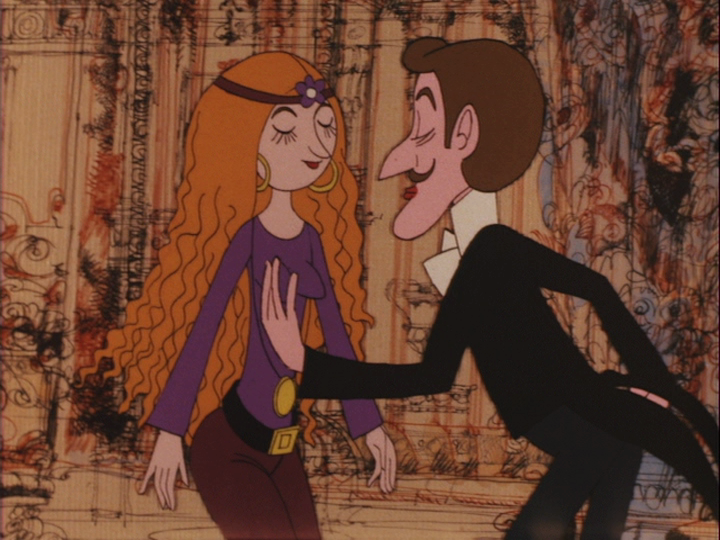
his guitar. A former student and a young teacher play at having a fling,
while the "Babbling Hot Springs Vixens" tell unusual stories of human
fallibility. The previously mentioned instructor describes his dreams,
while the Moles return to deliver - maternity style - their miniature
friend from the orifice of an alien television. The horrors of high
school homeroom are uncovered, while various polymorphous shapes and
biological abominations demand intimacy and gratification. If it all
sounds like David Cronenberg via Shinya Tsukamoto, you're only partially
correct. Like Pee Wee's Playhouse soaked in blowfish venom, this is one
filmic forest that truly lives up to its funky namesake.
At first, the over the top goofiness and incoherent shrillness are
off-putting. The Moles are like prop comics who forgot their bag of
tricks...or punchlines. They shout and stutter, playing on Asian
stereotypes in an almost offensive manner. There are plenty of nods and
winks to keep things in perspective, but it does start the film off on
an odd footing. Then we get the weird animated battle between Little
Hataru and some pulsating blob. Yet the ending turns out to be a jokey
non-sequitor. The Unpopular with Women Brothers include a mature
worrywart, an axe strumming hippy type, and a grade schooler who can't
stop shoveling chocolate into his mouth. Their moments have an
observational wit to them, that is, when Funky Forest doesn't overplay
their part in the effort. Indeed, there are several sequences that go on
for far too long. When we learn about the almost-affair between teacher
Takefumi and a young student, we are intrigued. But then their
storyline shifts into a nearly 40 minute musical pastiche, including
numerous interpretive dance numbers and some Power Station like
animation. By the end, we are desperate for a rationale.